I Started HRT About 10 Years After Menopause: How It’s Going at 65
For Years, I Thought I Would Never Take Hormones
I wanted to go through menopause naturally.
I didn’t take medications, and HRT felt unnatural to me. I also thought it was unsafe, based on the current information at the time. So I went through menopause without it and figured that was how I would continue.
Then the conversation around hormones got louder. And, I notieced changes happening that I didnt understand in my body.
I was listening to podcasts and reading articles and books about HRT, safety, and possible long-term health benefits. I started paying attention to a subject I’d pretty much dismissed.
Changing my mind was fairly straightforward once I learned more. I wanted to explore whether it made sense for me.
By then, I was in my late 50s or early 60s, about 10 years past menopause.
Now I’m 65, and estrogen, testosterone, and progesterone are part of my daily routine. Which is funny, considering how sure I once was that I wouldn’t take them.
What Interested Me Enough to Explore HRT
My main interest was long-term health.
I wanted to understand more about metabolic and heart health, along with my bones, muscle, and skin. Those were the subjects that kept coming up in what I was reading and listening to, and I wanted to ask questions about my own situation.
I was actually one of the first in my circle to start. Most of what prompted me to explore it came from podcasts, articles, and books.
Once I decided to look into it, I needed to find someone who could help me understand my options.
How I Found My Provider
I began asking my women friends whether they were using HRT and whether they were happy with their provider.
And let me tell you, women love talking about this.
Those conversations gave me somewhere to begin. I began with my Naturopathic Dr., and eventually found a provider who specialized in hormone therapy, went through an evaluation, and decided I wanted to try it.
I think that’s a useful distinction in my story. Reading and listening made me reconsider. Finding a knowledgeable providers gave me a way to explore what that meant for me.
I Was Already About 10 Years Past Menopause
This is the part that deserves more attention than simply saying I started “after menopause.”
I was about a decade past it.
Women often hear that by then, it’s too late to start HRT. The timing guidance is more nuanced than an automatic cutoff, although starting later does warrant a careful assessment.
Much of the evidence behind that guidance comes from studies using specific oral hormone formulations. Those studies included older women, but they didn’t test the cream-and-progesterone regimen I use. There are still unanswered questions about different treatments, and The Menopause Society’s guidance recognizes that some women may choose to start later after discussing their individual risks and benefits.
I wanted to understand whether HRT was still an option for me, so I explored it.
My interest in heart and metabolic health was part of why I asked. That doesn’t mean I can claim my treatment will prevent a future health problem. HRT is not recommended solely to prevent heart disease.
But I wanted enough information to make a decision about my own health, rather than assume the subject was closed.
What Testing Did I Have?
I had a full hormone panel, along with thyroid testing and other bloodwork as part of my evaluation.
The broader testing included a complete blood count, a comprehensive metabolic panel, blood sugar markers, inflammation markers, and vitamin D.
That was my workup. I’m sharing it because “What labs did you have?” was one of the questions I received after posting my original video.
It’s an account of what was ordered for me, rather than a checklist every woman needs to follow.

What My HRT Actually Looks Like
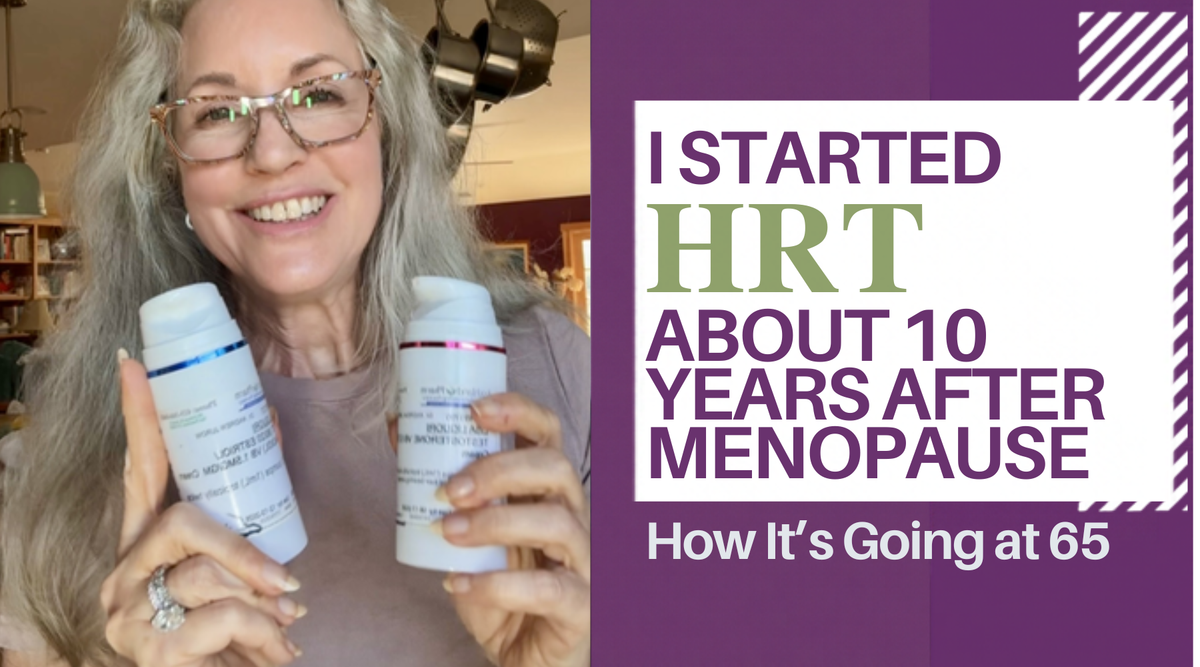
Recently, I shared an Instagram video showing my prescriptions and how I use them. I get a lot of questions about the practical details, so here’s my routine.
My estrogen
I use a compounded estrogen cream on my skin twice a day, morning and evening.
My testosterone
I use a compounded testosterone cream in the morning.
My progesterone
I take 100 mg of oral progesterone each evening, usually around 7 p.m.
The creams have become part of my morning and evening routines. Taking progesterone in the evening is familiar now, too. I don’t spend much time thinking about the routine.
Watch My HRT Routine
In this video, I show what I use and explain when I take each hormone.
What Have I Actually Noticed?
Better sleep and somewhat better energy, but nothing huge.
Progesterone has helped me sleep a bit better. A bit is the important part. It hasn’t solved my sleep, and I wouldn’t describe the improvement as dramatic.
I appreciate it, though.
My overall energy levels improved somewhat as well.
I think that’s worth saying because when someone shares that she uses HRT, the next question is usually, “What did it do for you?”
That’s my answer. The changes I’ve noticed have been modest. My main interest has been long-term health.
Why My Doses Aren’t a Guide for Someone Else
I understand wanting the details. I had questions myself when I began exploring this.
But two pumps of my cream may deliver a different amount from two pumps of another cream. The concentration matters, and another woman’s prescription may look quite different.
These are my prescribed hormones and doses. Showing them helps explain what HRT looks like in my day, but it doesn’t tell someone else what she needs.
How It’s Going at 65
HRT has become a normal part of my life.
I started about 10 years after menopause, after years of thinking it wasn’t something I would ever use. Learning more changed my mind enough to explore it, and I’m glad I did.
I can tell you what I take and what I’ve noticed. I can’t separate out every effect or tell from how I feel what it might mean for my health years from now.
What I can say is that I’m comfortable asking questions and reconsidering an earlier decision when I learn something new.
For a long time, “going naturally” felt like the right choice to me. Later, I wanted to understand my options more fully.
And here I am at 65, applying my creams in the morning and evening and taking progesterone in the evening. Something I once thought I’d never do is now a very ordinary part of my day.
Books & Resources
Here are two books on menopause, hormones, and staying strong as we get older.

Next Level I’ve read this one for its discussion of muscle and training through menopause and beyond. It also covers hormone therapy. |

The New Menopause A resource on menopause, hormone therapy, and understanding your options. |
For a podcast on menopause and midlife health, Dr. Mary Claire Haver also hosts unPAUSED.
More About My Life at 65
For a look at my food, strength training, skincare, walks, and daily routine, read My Dailies at 65: The Habits That Support How I Age.
Join My Well-Aging Community
Inside my private community, I share more about food, skincare, strength training, and what I’m trying at 65.
Join Well Aging with Lisa | Simple Beauty Minerals.
Shop My Curated Favorites
You’ll find more of the food, kitchen, beauty, and fitness products I use on ShopMy.
Well Age With Me on Instagram
Follow me on Instagram, @lisadliguori, for more of what I’m cooking, how I train, and how I take care of my skin at 65.
**DISCLOSURE: Hey beautiful! I may be an affiliate for some of the products that I recommend on the Simple Beauty Blog. If you purchase those items through my links, I will earn a small commission. You will NEVER pay more when buying a product through my link. Plus, when you order through my link, it helps support the Simple Beauty Blog, so I can continue to offer you lots of great free information.